Wednesday, October 5, 2016

Hurricanes and Halloween in First Grade

Lately, I've been a bad blogger but a super okay mom and teacher. I CAN'T BE EVERYTHING TO EVERYONE ALL THE TIME!!!!!!Okay??! *insert crazy eyed emoji*

Here are my excuses:
1. I moved. (Please see: I guess I'm living in Florida 4EVA because that's never happening again. Girl bye.)

2. I traveled. On a train, to New York, with two kids under five. There were fun parts. I swear.
3. I switched grades. (2nd to 1st and wow what a difference! I miss 2nd grade but I also like 1st a lot it turns out.)
4. I fall asleep dead nightly as soon as my youngest's eyes shut.

I don't know how some of you ladies do this juggling teacher-mom-blogger-etc. act but I'll have whatever you're having with an extra shot.

Nonetheless, we've been pretty busy in our first grade classroom so far this year and we (mostly me) are very excited that this mysterious season called Fall is upon us. I think it's a time of year when the air cools and leaves (not palm frawns) turn brown. Here in South Florida we half-heartedly have ICED pumpkin spice lattes and wait impatiently for January temperatures to make us feel like we get at least one seasonal change. 

We are currently bracing for Hurricane Matthew who should be arriving tomorrow night to my area. Safe wishes to everyone along the treasure coast and the Carolinas too. My students know there is a storm coming so in an effort to make light of the situation we read the classic tale Cloudy With a Chance of Meatballs and wrote about what we would want it to rain instead of meatballs (Spoiler Alert: ice cream and cupcakes were the clear winners). Of course I don't have a picture of their writing because BADBLOGGER. (We used this perfect freebie for our writing and cut out pictures of our favorite foods from my unhealthy sized collection of Food Channel magazines.)


Follow me on Instagram @sharpinsecond

Fall is supposed to mean Halloween not hurricanes! And Halloween math centers are my favorite. Here is a fun way we are practicing our addition facts. I wrote numbers 5-9 on the cauldrons and then number sentences on the sticks for every fact (and tried to reinforce the commutative property). I also created a fact checker page for them to use when they finish sorting. The cauldrons were $1 at Target.
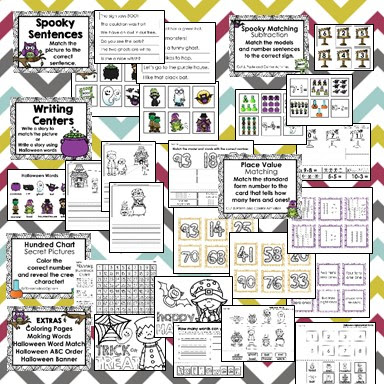
I had a lot of fun making a Halloween themed math and literacy pack to use this month with my first graders too. I love Whimsy Clips Not-So Spooky clipart. So cute! I think my kids are going to especially love the writing centers and the picture prompts! I also wanted to include place value seat work and math centers since we will be focusing on those concepts (oy vey) until November. Click {HERE} to check it out.
https://www.teacherspayteachers.com/Product/Halloween-Math-and-Literacy-for-Young-Learners-2799439

{HERE} is a freebie for you from that pack too!

This year I have also been using a self-running PowerPoint presentation I created to run my reading and math groups. The CLEAN UP slide and defining *chime* noise has really helped get my kids better at transitioning to their next center but we are still workin' on it. Click the picture below to see the rotation board options I have listed in my tpt store.

https://www.teacherspayteachers.com/Product/Editable-Center-Rotations-PowerPoint-Colorful-Chalkboard-Theme-2757027
This marks my fourth year teaching and I am starting to feel like I have much more of a handle on a lot of the nuances of running a classroom. I'm excited to see where the year takes me as I am told first graders grow so much in just one short school year! There is tons of foundational learning going on and it's already pretty cool to see how far they've come since day 1. I will post some more from our classroom soon - here's hoping the power isn't out too long. Hurricanes are no fun. Stay safe everyone!!!!


Sunday, April 24, 2016

I Failed at Flexible Seating


Updated 7/29/16: Hi and thank you so much for stumbling upon my blog! The below post (from  April 2016) was written as a way for me to document my experience with alternative, or flexible, classroom seating. It's not meant to persuade you against the concept or to say you shouldn't try it out in your own classroom! I was inspired to try it in my own room because of the many amazing teachers that have made it work so wonderfully for themselves and their students. Going full throttle into it wasn't for me but I love letting my students have some freedoms of course - standing to work if needed, working with clipboards on the rug, fun reading seating, etc. Having reflected on my own experience since publishing this post, I think I struggled a lot with how my students would cope the next school year in a desk. Was I setting them up for failure by giving them too much choice? That's question went through my head a lot. But I digress!

Flexibility is the backbone of teaching and I also believe in life you must take risks. I suppose that's why I jumped head first into transforming my room to begin with. I have no regrets! What I'm trying to say is... If you feel flexible seating could work for your class I hope you'll go for it! Let us know in the comments how it goes.

--------------

Back in November I blogged about how I had transformed my classroom with flexible seating, otherwise known as alternative seating. I jumped head first into the idea that my students would choose their work space and get down to business and that each day would be buzzing with the hum of productivity and engagement. That was the idea. The reality looked and sounded a lot different. I don't consider myself a super traditional person. By that I guess I mean that for the most part, I like to take risks and try new things. I immediately thought flexible classroom seating would be a perfect fit for my teaching style. Turns out I am much more traditional than I thought. My mom will be so excited!

I failed at implementing flexible seating in my classroom. I just couldn't make it work. I could list reasons for why I think it didn't work out but I fear they may sound a lot like excuses. Perhaps they are. I really wanted to like the new set up, to trust my students' decisions and partnerships, but as the days passed, I knew alternative seating wasn't going to work for me or my kids. Add a couple days of substitute teachers and I was truly over it!


via the Corner Stone for Teachers Facebook

Like a lot of things in life, my big plans fell short of what I expected. I couldn't manage my students' behaviors or needs as well when they were choosing their own workspaces. I fully believe that kids need movement and hands-on learning and they still get tons of that but when I switched my students back to assigned desks, I couldn't help but feel a sense of failure. Why couldn't I make it work? Why can't my classroom have the same vibe as the classrooms I see on Pinterest with their stability balls and fancy couches? WHY don't they understand that stability balls aren't meant for rolling yourself across the room?

The answer for why I failed is probably simple. I wasn't buying into it 100%. I worried about how my students would cope next year in a traditional desk scenario. I dreaded daily transitions. All the walking around made my eye twitch! And I worried that I was going to cry if they didn't stop talking off topic so much!!! The whole vibe of my classroom just felt off.

Since I've switched back to traditional seats, we've been engrossed in an author study, researched rainforest animals, experimented with rainbows, and so much more. I realized I don't need to make a grand classroom change in order for my students to thrive and learn. I'm not sure if it makes me a better or worse teacher but for me, a traditional classroom has just been a better fit this year.

Now if you'll excuse me I have some stability balls to deflate.


Saturday, April 23, 2016

Using Playing Cards For Math Centers and Why It's AWESOME


The concept of using playing cards for math centers is not a new one. It's an awesome one though! In previous years, my math centers consisted of mostly printing, laminating, bagging, repeat. Switching them out constantly gets overwhelming for me. And cutting lamination loses its allure reeeeal fast. Switching out centers weekly causes me anxiety! Call me lazy but the rare few minutes I have alone (mom of 2 under 5 here) mustn’t be wasted cutting out a math center my students might use for a week. I still LOVE a lot the printables I have purchased and, when a unit calls for them, they more than work. When I discovered how much diversity a deck of cards could lend to my math block, the almost complete switch however, was a no-brainier.
 Students love playing with cards because they truly feel like they're getting away with just playing during math time. The novelty doesn't wear off either. My card centers have been going strong all year. Each time I introduce a new card game the "oooohs" and "ahhhs" resound.

 I teach second but card games are adaptable to meet the needs of any grade level. The list I have assembled of my top three favorite math center card games are geared towards primary aged students but you may be able to adjust by slightly changing the rules or objective. Check out them out!

 (All games require you to remove the Kings, Queens, Aces, Jokers, and Jacks unless otherwise noted)

 1. Flip Three, by Who’s Who and New

Description: A memory game of sorts where players aim to create a meaningful equation with the three cards they flip. Number of players: I find 4-5 works best Rationale: Students are using and fine tuning number sense as well as practicing fact families. They also must pay close attention as their opponents choose cards so they can make smart choices when their own turn comes. I like how this game challenges their focus and tact. How to play: Arrange your cards into five rows of seven facing down. Player one flips three cards over, leaving them on the board. If those three cards can make an equation they take them. If they don't they flip them back over and the next person goes. Play until there are seven cards left on the board. Player with the most cards wins!
Please observe my weenie dog cards and be jealous!
 2. The Greatest Game, adapted from education.com

Description: I use this game to help students practice double-digit addition. You can adapt it to two-digit subtraction or to three digit addition/subtraction as well. Number of players: 2-5 Rationale: Students are practicing comparing numbers, facts, and regrouping and/or borrowing skills. They are also creating arrays! How to play: Remove the 10's from the deck (as well as all other face cards). Each player gets four cards. They arrange their cards to create two of the biggest two-digit numbers they can. The cards should be in two rows of two cards. Everyone adds their own cards up to reveal who has the biggest sum. The winner takes everyone's cards. You can add a one-minute timer if you feel the group can handle it! Play until you're out of cards! Winner is whoever has the most cards. To adapt to three-digit adding or subtracting, give each player six cards instead of four.


3. Make a Ten Game, adapted from a sweet blog post by Math Coach’s Corner

Description: The game is simple and isn't set up for a singular winner. It's more of a group effort type of game. I use this game to drill ten’s facts into my student’s heads! It can get noisy. Be forewarned! This game also has a fun surprise at the end.
Number of players: 4 maximum Rationale: Students are practicing ten facts which are crucial to adding and subtracting larger sums. They are also doing a bit of missing addend work. How to play: In this game Aces = 1, so leave the Aces in the deck but remove all other face cards. One player will choose one card and place it face down off to the side (No peeking!). The rest of the cards will be laid out face up into five rows of eight (one row will only have 7 cards). Each player gets a turn choosing cards that combine to make ten. They must say the fact out loud as they pick up the cards! For 10 + 0, they will just pick up the 10. If you want to add extra suspense for your students that have their tens facts pretty much mastered, add a one-minute timer. Once there is one card left, the group must guess what the secret card is (ya know, the card we picked out and didn’t look at before we laid out the cards)! They love that part.
Ace = 1

So that’s it! These three games have kept my students busy all year. I occasionally throw in holiday themed centers and I do still have a few laminated centers as well, but the cards are the STAHS!!!

One last thing! Since different games require the deck of cards to look different, I like to keep my decks in soap containers. I label each soap container on the bottom with which games that deck goes with. Some decks will work for multiple games.

I hope you enjoyed this post and got an idea or two for your math centers!